
Automation and digital transformation are critical to achieve process reliability
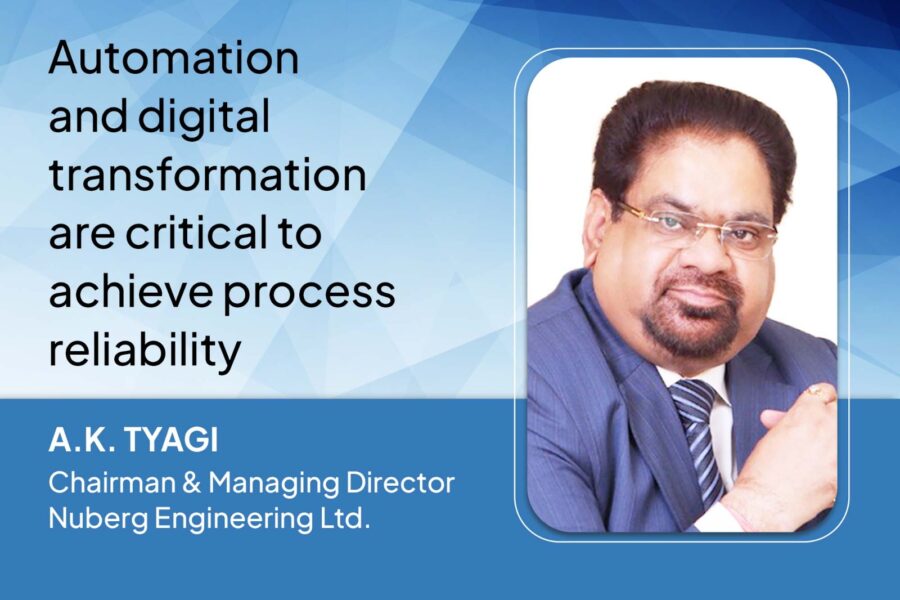
Implementation of Advanced Distributed Control Systems (DCS) and IoT-enabled process monitoring platforms allows for continuous, real-time oversight of plant conditions. A.K. Tyagi, Chairman & Managing Director, Nuberg Engineering Ltd., discusses, We leverage AI and big data analytics for predictive maintenance, minimising downtime and equipment failures.
How is Nuberg EPC leveraging automation technologies to enhance efficiency and precision in its turnkey project execution?
Our automation is central to how we deliver precision, predictability, and efficiency in turnkey projects across the chemical, fertiliser, and process industries. By integrating Digital Twins, 4D/5D BIM, and laser scanning with modular skid-based fabrication, robotic welding, and digital QA/QC of modules, we significantly accelerate construction cycles while reducing onsite risks.
Our IoT-enabled monitoring systems, AI-driven predictive analytics, and drone inspections provide real-time oversight of assets and project performance, while RPA-enabled procurement, blockchain-based smart contracts, and fraud-proof vendor tracking ensure transparent, secure, and efficient procurement cycles. AR/VR-based training tools prepare our engineering teams for complex execution challenges, and real-time dashboards allow stakeholders to track progress and risks instantaneously.
Collectively, these technologies and processes enable us to compress delivery timelines, minimise operational risks, and consistently achieve high precision in design, fabrication, and execution, thereby setting new benchmarks for turnkey project delivery within critical industrial sectors.
What specific automation systems or digital tools has Nuberg EPC integrated into its chemical and fertiliser plant projects to improve process reliability and safety?
Across the chemical and fertiliser sectors, we recognise that automation and digital transformation have become critical to achieving process reliability and operational safety. Our implementation of Advanced Distributed Control Systems (DCS) and IoT-enabled process monitoring platforms allows for continuous, real-time oversight of plant conditions. We leverage AI and big data analytics for predictive maintenance, minimising downtime and equipment failures.
Meanwhile, digital twin technology enables us to optimise plant performance through simulation before physical deployment. AR/VR-based safety training tools improve workforce preparedness, and 3D modelling software ensures engineering accuracy throughout the design-to-execution cycle. Onsite reliability is further enhanced with drone-based inspections, smart alarms, automated interlocks, and advanced gas-leak detection systems. Together, these technologies empower us to establish new industry standards for reliability, precision, and safety compliance, setting a benchmark for exceptional execution in critical industrial infrastructure.
How has automation evolved in your industry segment over the past few years, and what trends are driving adoption now?
In the process industry EPC segment, automation has transitioned from isolated efficiency improvements to fully integrated digital ecosystems. Over recent years, companies have moved beyond manual workflows and standalone control systems to deploy real-time IoT monitoring, digital twin-based design environments, AI- and ML-powered predictive analytics, 4D/5D BIM, and cloud-enabled project collaboration platforms. These technologies are now central to managing complex global supply chains, ensuring design accuracy, and enhancing safety across chemical, fertiliser, and allied process plants.
Current market drivers include the push for energy-efficient infrastructure, enhancing global compliance standards, and rising client expectations for data transparency, lifecycle visibility, and shorter project timelines. As the industry aligns with sustainability and renewable-energy objectives, leading EPC players are leveraging these digital capabilities to deliver ultra-efficient, low-risk, and future-ready plant solutions towards an approach increasingly visible in the way modern turnkey project specialists operate today, including Nuberg EPC.
In what ways has Nuberg EPC adopted automated design and engineering platforms, such as 3D modelling or digital twin technology, to streamline project planning and delivery?
We have set ourselves apart in the EPC sector by systematically deploying automated design and engineering platforms, especially 3D modelling, digital twin technology, and AI-enabled tools to transform project delivery from concept to commissioning. The company’s approach starts with the use of 3D modelling and simulation techniques at the design stage. For example, during India’s first commercial-scale hydrogen purification and dispensing facility, Nuberg EPC implemented extensive 3D digital modelling and virtual reality (VR) to visualise plant layouts, simulate project conditions, and identify potential bottlenecks at an early stage. This digital-first methodology enabled real-time design adjustments, avoided physical clashes, and led to significant savings on rework and delays.
Digital twin technology is now central to our project execution. In key projects, such as the 400 TPD Sulphur Recovery Unit (SRU) and IOCL’s Bio-Ethanol plant, we have developed digital twins as virtual replicas of the actual plants. These digital twins provide live monitoring, operational analytics, and predictive maintenance insights using IoT sensor data. With this capability, project teams and clients can visualise, simulate, and optimise plant performance before construction, resulting in better resource planning, risk mitigation, and more confident, data-driven decisions.
All these digital solutions operate within cloud-based collaborative platforms that connect dispersed engineering and project management teams. Such platforms allow seamless data sharing and process automation between departments, boosting operational efficiency and communication. Cloud technologies also empower us to maintain documentation, manage workflows, and ensure compliance across global project sites.
Augmented reality (AR) and VR are used not just for internal design reviews but also to conduct safety training and enhance stakeholder engagement by letting clients virtually “walk through” and validate design choices. Furthermore, AI-powered analytics combining data from digital models and IoT devices enables us to predict machinery health, optimise asset use, and ensure timely interventions that keep projects on track and under budget.
Real-world results from these efforts include faster plant commissioning, fewer construction errors, and a measurable increase in customer satisfaction and trust. Our digital transformation exemplifies how advanced technologies, when woven systematically into EPC workflows, change the game for efficiency, agility, and project quality in the global industrial sector.
How are AI and data analytics helping improve automation performance and decision-making?
AI and data analytics are redefining automation performance and decision-making at our company by driving accuracy, agility, and data-driven insights across engineering, procurement, and construction phases. Technologies like AR and VR support immersive design reviews that allow engineering teams to visualise complex plant layouts before construction begins, enhancing safety, precision, and stakeholder alignment. These technologies also enable virtual safety training and effective cross-functional communication, ensuring worksite readiness and risk mitigation well in advance.
AI-backed procurement tools contribute to more intelligent project planning by improving demand forecasting, aligning vendor capabilities with project needs, and streamlining supply chain management. This helps reduce procurement delays, ensure material availability, and maintain project timelines even across geographically diverse operations.
Cloud-based collaboration platforms further extend the reach of AI and analytics by connecting globally distributed engineering centres. Teams can co-engineer in real time, track progress transparently, and make informed decisions collectively using real-time project dashboards and digital documentation. Digital twin models and IoT-enabled sensors play a crucial role in predictive monitoring by offering live performance data and enabling proactive maintenance strategies. This improves asset reliability, minimises downtime, and enhances overall project execution efficiency.
Together, AI, analytics, and real-time automation form a unified digital framework that drives smarter design, faster decision-making, reduced risks, and superior execution outcomes. Our adoption of these technologies enables its global projects to be more cost-effective, efficient, and future-ready—continuing to set benchmarks in innovation-driven EPC excellence while advancing sustainability through energy-efficient solutions and optimising manpower deployment for safer, more productive project execution.
How is Nuberg EPC preparing its teams and operations to adapt to next-generation automation trends, such as AI-assisted control systems or smart plant monitoring?
We are strategically positioning ourselves by embedding digital innovation at the core of our EPC strategy. Through advanced technologies like digital twin systems, IoT integration, and AI-driven analytics, the company enhances real-time monitoring, predictive maintenance, and operational efficiency across project lifecycles.
A prime example is one of India’s largest Chlor-Alkali projects with Adani Mundra Petrochemicals in Gujarat, where digital twin and smart plant monitoring enabled timely execution with high safety and performance standards. Complementing its traditional engineering strengths, we are building deep digital expertise, leveraging AI-enabled systems to automate processes and optimise plant performance. Its in-house fabrication and modular manufacturing further support agile deployment of smart controls, reducing lead times and improving flexibility. Continuous upskilling of teams in advanced automation ensures the company’s readiness for next-generation project delivery. By merging technology, innovation, and sustainability, we are redefining EPC execution by delivering smarter, safer green energy plants worldwide.
© This article was first published in OEM UPDATE, 29 December, 2025.
